What is EPCRA?
The Superfund Amendments and Reauthorization Act (SARA) was signed into federal law in 1986 in response to concerns regarding the environmental and safety hazards posed by the storage and handling of hazardous chemicals. These concerns were triggered by the 1984 disaster in Bhopal, India, caused by an accidental release of methylisocyanate which killed and injured thousands of people. Title III of SARA is known as the Emergency Planning and Community Right-To-Know Act (EPCRA). The U.S. Environmental Protection Agency (U.S. EPA) enforces EPCRA. The regulations implementing EPCRA are codified in Title 40 of the Code of Federal Regulations (CFR), Subchapter J, Parts 302 through 372. The Governor of each State was charged with creating a State Emergency Response Commission (SERC).
What is the AERC?
In 1987, Executive Order Number 4 created the Alabama Emergency Response Commission (AERC) by appointing the Alabama Emergency Management Agency (AEMA) and the Alabama Department of Environmental Management (ADEM) acting in concert to carry out the provisions of the Act. AEMA is responsible for establishing and overseeing the activities and training of local emergency planning committees (LEPCs).
As co-chair to the Commission, ADEM is responsible for reviewing, maintaining, and serving as the data repository for documents required to be filed by various industry throughout the state. These documents include: Extremely Hazardous Substance (EHS) Notifications, Emergency Release Written Follow-up Notifications, Safety Data Sheets (SDSs), Tier II Hazardous Chemical Inventory Reports, and the Toxics Release Inventory (TRI). Data from these documents are compiled and made available by request to the public and Local Emergency Planning Committees (LEPCs) for use in emergency situations, to analyze release trends, and to facilitate awareness of hazardous materials in communities.
How does Alabama implement EPCRA?
Alabama defers to the Federal EPCRA regulations for both reporting thresholds and compliance determination. The AERC requires each facility filing under EPCRA to obtain a location-based Master ID number that is to be included when submitting EPCRA documents. For more information about obtaining Master IDs and other state required fields click here (LINK TO THAT NEW PAGE). See the navigation pane on the left side of this page to see a breakdown of reporting requirements for each EPCRA section.
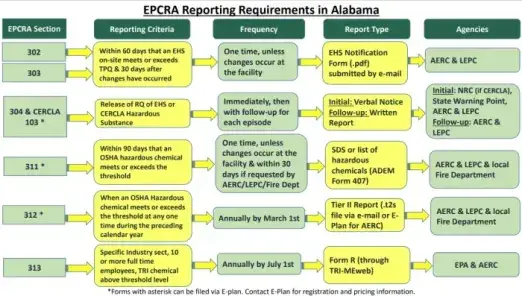
A PDF of this chart can be obtained here.
AERC Contacts
EPCRA Coordinator: Beth Donaldson beth.donaldson@adem.alabama.gov / 334-394-4306
Emergency Response / RRT Representative: Grady Springer gspringer@adem.alabama.gov / 334-260-2717
LEPC Coordinator: Caleb Williams caleb.williams@ema.alabama.gov / 205-280-2244
EPCRA Updates
For an ongoing list of Federal updates to EPCRA (Non-Section 313) please see: https://www.epa.gov/epcra/emergency-planning-and-community-right-know-act-non-section-313-regulations-and-amendments
Resources
- AERC’s Annual Newsletter: Industry Highlights – EPCRA Updates
- To find your LEPC, contact your county’s EMA Director
- EPA’s EPCRA Guidance Documents and Fact Sheets
- ADEM Emergency Response